Choose the Right Editing Level for Your Manuscript
Every manuscript requires a different level of editorial support depending on its current stage, revision needs, and publishing goals.
FirstEditing uses a structured cumulative editing model designed to strengthen your manuscript progressively while guiding revision in the correct sequence.
Find out which editing level your manuscript needs – Free!

Professional Editors Trusted by Over 50,000 Writers Since 1993
Each editing level addresses a distinct stage of your writing and revision process. Your editor corrects structural issues, clarity concerns, sentence-level refinement, and technical problems at the appropriate time.
Ask your editor to review your manuscript and provide a professional recommendation.
Having an editor review your manuscript first helps you:

Many authors know the manuscript still does not feel fully clear, polished, professional, or publication-ready but are unsure which editing stage will resolve their specific problem most effectively.
Whether your manuscript requires structural guidance, direct refinement, paragraph-level clarity improvement, sentence-level polishing, or final technical correction, you can now understand how each editing level functions and when it should be used.
Executive Content Editing helps authors move through revision more efficiently by directly implementing high-impact improvements within the manuscript.
Editing is performed based on your manuscript’s current needs and the level of editorial support required or desired by you.
Each editing level addresses a different stage of revision so the right work is performed at the right time.
The guidelines below help identify the appropriate editing level based on the type of revision your manuscript requires.
If the correct editing level is unclear or you simply want to be 100% sure, submit a sample of your writing. We will reply with a free editing sample and a professional recommendation.
Your editor reviews the manuscript and recommends the editing level that best aligns with your manuscript’s current stage and revision needs.
Authors may also request a higher level of support when more comprehensive guidance or direct refinement is desired.
Traditionally, freelance editors and standard editing service companies treat editing levels as separate, standalone services, reviewing only the issues that fall within one narrow scope. This leaves important manuscript needs unaddressed, resulting in fragmented feedback, duplicated effort, and confusion about which service is actually needed.
FirstEditing’s cumulative editing model solves this by aligning the right editorial support with the right stage of the manuscript. Structural issues are addressed before sentence-level refinement, clarity is strengthened before final polish, and each stage builds on the work beneath it so the manuscript improves efficiently as a complete work.
With FirstEditing, you receive:
FirstEditing uses a unique, structured cumulative editing model in which each editing level builds on the foundations of the levels beneath it while maintaining a distinct primary focus.
Rather than treating editing as isolated corrections, the manuscript improves progressively through a clear editorial sequence.
This approach helps authors receive the right level of support at the right stage. You are assured:
You get a professional editorial process designed to strengthen both your manuscript and improve your revision experience.

Starting at the right editing level ensures your manuscript is strong.
The cumulative editing system is designed to strengthen manuscripts progressively through the correct editorial sequence.
This approach helps authors like you:
Every editing level builds logically on the previous stage, creating a clearer path from early revision to final publication readiness.
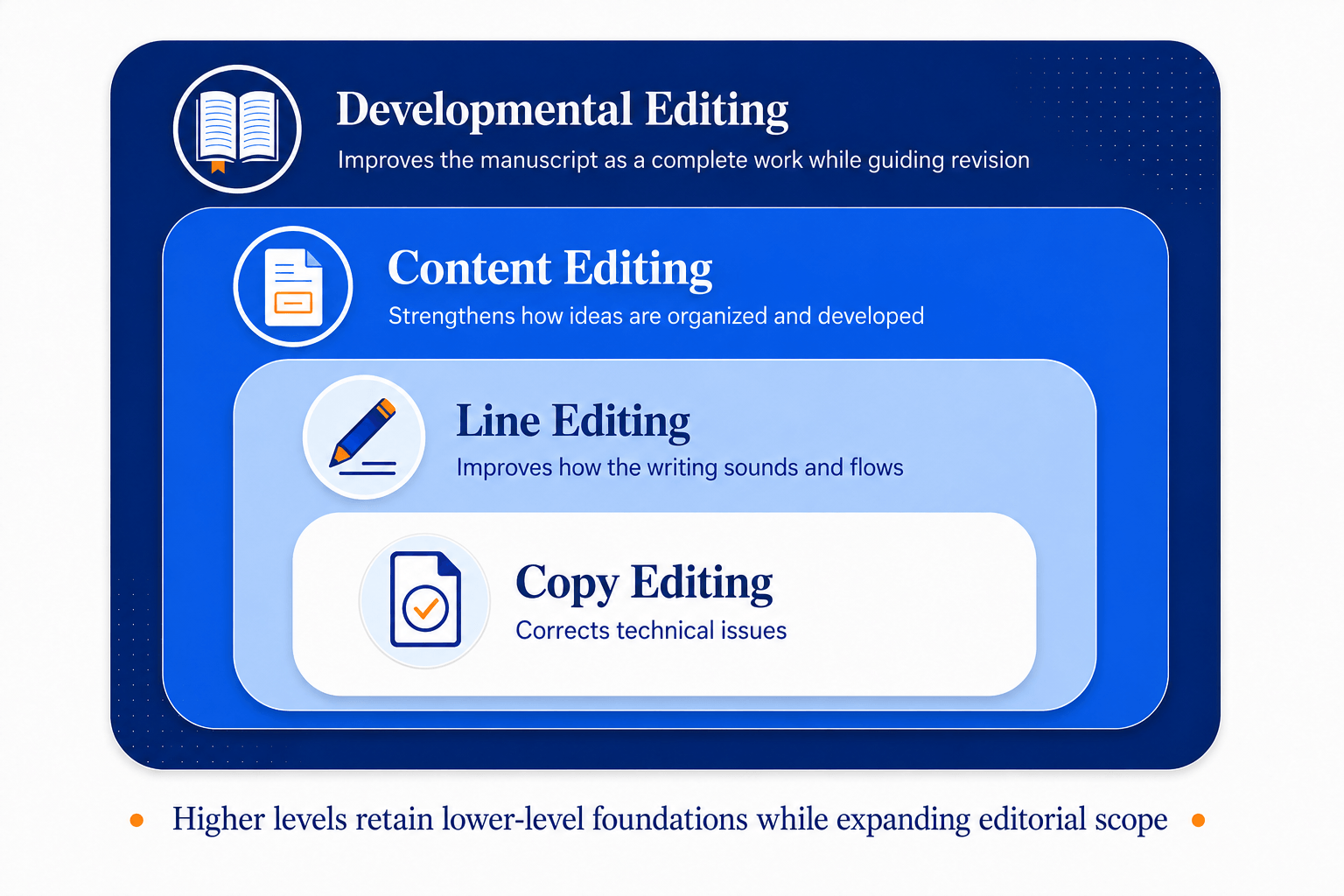
Level 5 — Developmental Editing
(Structural Editing / Manuscript Evaluation)
Structure, organization, pacing, manuscript effectiveness, and revision guidance
Level 4 — Executive Content Editing
(Advanced Content Refinement / Substantive Editing)
Direct refinement, substantive sentence-level improvement, and professional-level presentation enhancement
Level 3 — Content Editing
Paragraph- and section-level clarity, organization, transitions, and coherence
Level 2 — Line Editing
Sentence-level readability, flow, tone, clarity, and stylistic refinement
Level 1 — Copy Editing
Grammar, punctuation, consistency, technical correction, and style-guide accuracy
Each editing level builds progressively on the previous stage while maintaining a distinct editorial focus.
This helps ensure manuscripts improve in the correct sequence rather than polishing issues that should first be revised structurally.
| Editing Level | Primary Focus | What Your Editor Does | When to Choose | Why This Matters |
| Developmental Editing | Manuscript-level structure and revision guidance | Evaluates your manuscript as a complete work and provides detailed developmental guidance for revision | Your manuscript requires structural improvement, stronger organization, pacing refinement, or manuscript-level revision guidance | Helps you prevent structural and developmental issues from weakening the manuscript |
| Executive Content Editing | Direct refinement and advanced editorial execution | Implements direct sentence- and paragraph-level refinement to strengthen clarity, readability, tone, and presentation | Your manuscript structure is established, but the writing requires higher-support refinement and direct editorial execution | Strengthens your professional presentation while preserving your voice |
| Content Editing | Paragraph- and section-level clarity and organization | Improves clarity, coherence, organization, and transitions within your manuscript’s existing structure | Your manuscript structure is stable, but sections and paragraphs require stronger clarity and flow | Improves readability and communication effectiveness |
| Line Editing | Sentence-level refinement | Refines sentence clarity, readability, tone, flow, and stylistic consistency while preserving meaning and your voice | The manuscript requires smoother, clearer sentence-level writing | Strengthens readability and your reader engagement |
| Copy Editing | Technical correction and consistency | Corrects grammar, spelling, punctuation, consistency, and style-guide issues | Your revisions are complete and the manuscript is ready for final technical correction | Ensures technical accuracy before manuscript preparation and publication |
Your manuscript progresses through a structured editorial sequence designed to address the correct issues at the correct stage.
Developmental Editing → strengthens your manuscript’s foundation, organization, developmental clarity, and revision direction
Executive Content Editing → provides direct refinement and advanced editorial execution
Content Editing → improves paragraph-level clarity, organization, and coherence
Line Editing → strengthens readability, sentence flow, tone, and stylistic clarity
Copy Editing → ensures grammar, punctuation, consistency, and technical correctness
This cumulative process:
Authors may move between editing levels during revision depending on how the manuscript evolves.
FirstEditing’s cumulative editing model is designed to ensure the manuscript receives the appropriate level of editorial support at the correct stage.
Each editing level focuses on a distinct editorial purpose while still incorporating the foundations of lower editing levels where appropriate.
This helps prevent:
Higher-level editing may include selective examples or lower-level corrections where relevant, but each level maintains clear scope boundaries and a distinct editorial focus.
This structured approach strengthens both the manuscript and the overall revision process.
Developmental Editing improves manuscript structure, pacing, organization, progression, and overall manuscript effectiveness.
Line Editing improves sentence-level readability, flow, tone, clarity, and stylistic consistency.
Executive Content Editing includes direct editorial refinement and advanced sentence-level improvement while preserving the author’s voice and ownership.
Content Editing improves paragraph-level organization, transitions, coherence, and communication effectiveness within the manuscript’s existing structure.
Copy Editing is typically performed after revisions are complete to ensure grammar, punctuation, consistency, and technical accuracy before manuscript preparation and publication.
FirstEditing has helped over 50,000 writers strengthen manuscripts across fiction, nonfiction, academic, and professional publishing categories.
Instead of searching for and managing independent freelancers, authors receive structured editorial support from an established professional editing company with consistent editorial standards, cumulative revision methodology, manuscript-stage alignment, and long-term editorial structure.
This coordinated editorial system helps ensure authors receive editing aligned with the manuscript’s actual condition rather than isolated freelance corrections disconnected from the broader revision process.
Our editors:
The goal is not simply to correct isolated issues.
The goal is to strengthen the manuscript progressively while helping authors move through revision more effectively.
Developmental guidance, editorial refinement, and manuscript-stage recommendations are provided within a structured editorial framework designed to improve clarity, organization, readability, and publication readiness over time.
Check Out Our 5-Star Reviews from Customers Around the World! Feel Free to Scroll as Long as You Like…
Find the right editing level for your manuscript and receive professional guidance designed to strengthen your writing at the correct stage of revision.
Submit a sample of your manuscript for a professional recommendation.
Contact Us to discuss your project
No obligation • Professional guidance provided
Submit a sample of your writing. Your editor reviews the manuscript and recommends the editing level that best matches the manuscript’s current stage and revision needs.
Not necessarily. Manuscripts begin at the editing level that addresses the manuscript’s primary needs. However, later editing stages are still typically recommended as revision progresses.
Yes. Many manuscripts begin at the level that addresses the most significant issues first. Your editor recommends the appropriate starting point based on the manuscript’s condition.
Developmental Editing provides manuscript-level structural guidance and revision direction. Executive Content Editing provides direct editorial refinement and implementation within the manuscript itself.
Content Editing improves paragraph-level clarity, organization, coherence, and transitions. Line Editing focuses on sentence-level readability, flow, tone, and stylistic refinement.
Line Editing improves how the writing reads at the sentence level. Copy Editing provides final technical correction after revisions are complete.
No. FirstEditing editors strengthen clarity, readability, organization, and effectiveness while preserving the author’s voice, message, and intent.
A professional sample edit and recommendation help identify the manuscript’s current stage and determine the most effective next step.
AI tools may assist with brainstorming or basic correction, but professional editors provide manuscript-level analysis, contextual revision guidance, developmental insight, narrative and organizational evaluation, revision sequencing, preservation of author voice, editorial judgment, and cumulative editing support that automated tools cannot fully replicate.
The correct starting point depends on the manuscript’s current condition. Manuscripts with structural or developmental issues typically begin with Developmental Editing, while more polished manuscripts may begin at later editing stages.
Yes. Professional editing is a standard part of the publishing process for traditionally published authors, independently published authors, business writers, academics, and bestselling authors.
After Copy Editing, manuscripts typically move into manuscript preparation, formatting, and final publication production.
Lorem ipsum dolor sit amet, consectetur adipiscing elit. Ut elit tellus, luctus nec ullamcorper mattis, pulvinar dapibus leo.

